

DP-700 Certification - The Ultimate Guide [Updated 2026]
DP-700 Practice Exam and Study Guides - Verified By Exam4PDF
NEW QUESTION # 44
Your company has a sales department that uses two Fabric workspaces named Workspace1 and Workspace2.
The company decides to implement a domain strategy to organize the workspaces.
You need to ensure that a user can perform the following tasks:
Create a new domain for the sales department.
Create two subdomains: one for the east region and one for the west region.
Assign Workspace1 to the east region subdomain.
Assign Workspace2 to the west region subdomain.
The solution must follow the principle of least privilege.
Which role should you assign to the user?
- A. domain admin
- B. Fabric admin
- C. domain contributor
- D. workspace Admin
Answer: A
Explanation:
To implement a domain strategy and manage subdomains within Fabric, the domain admin role is the appropriate role for the user. A domain admin has the permissions necessary to:
Create a new domain (for the sales department).
Create subdomains (for the east and west regions).
Assign workspaces (such as Workspace1 and Workspace2) to the appropriate subdomains.
The domain admin role allows for managing the structure and organization of workspaces in the context of domains and subdomains while maintaining the principle of least privilege by limiting the user's access to managing the domain structure specifically.
NEW QUESTION # 45
Note: This question is part of a series of questions that present the same scenario. Each question in the series contains a unique solution that might meet the stated goals. Some question sets might have more than one correct solution, while others might not have a correct solution.
After you answer a question in this section, you will NOT be able to return to it. As a result, these questions will not appear in the review screen.
You have a Fabric eventstream that loads data into a table named Bike_Location in a KQL database. The table contains the following columns:
BikepointID
Street
Neighbourhood
No_Bikes
No_Empty_Docks
Timestamp
You need to apply transformation and filter logic to prepare the data for consumption. The solution must return data for a neighbourhood named Sands End when No_Bikes is at least 15. The results must be ordered by No_Bikes in ascending order.
Solution: You use the following code segment:
Does this meet the goal?
- A. no
- B. Yes
Answer: A
Explanation:
This code does not meet the goal because it uses order by, which is not valid in KQL. The correct term in KQL is sort by.
Correct code should look like:
NEW QUESTION # 46
DRAG DROP
You have a Fabric eventhouse that contains a KQL database. The database contains a table named TaxiData.
The following is a sample of the data in TaxiData.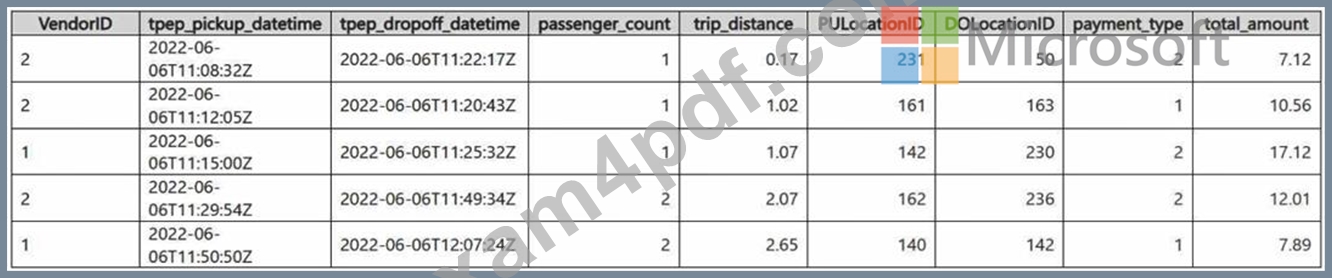
You need to build two KQL queries. The solution must meet the following requirements:
One of the queries must partition RunningTotalAmount by VendorID.
The other query must create a column named FirstPickupDateTime that shows the first value of each hour from tpep_pickup_datetime partitioned by payment_type.
How should you complete each query? To answer, drag the appropriate values the correct targets. Each value may be used once, more than once, or not at all. You may need to drag the split bar between panes or scroll to view content.
NOTE: Each correct selection is worth one point.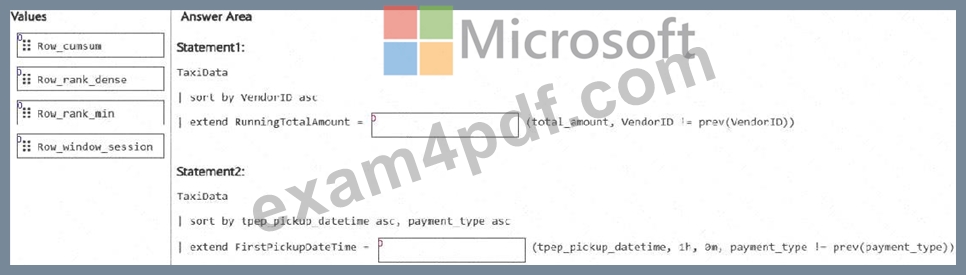
Answer:
Explanation: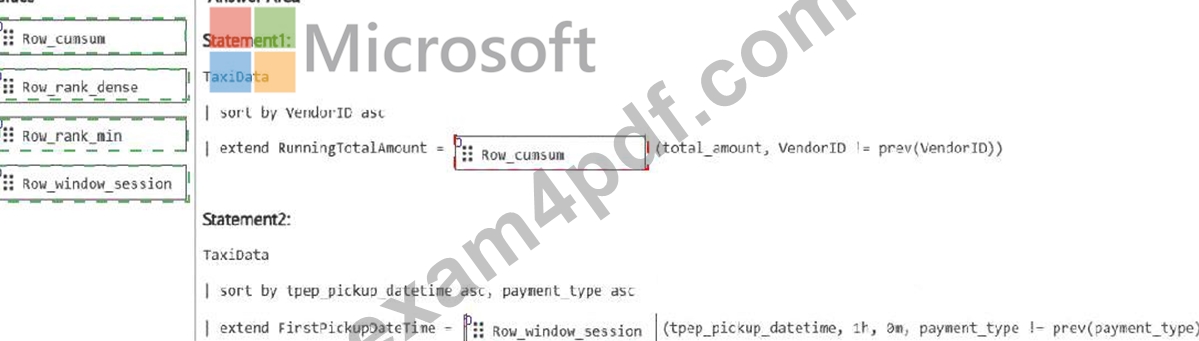
Explanation: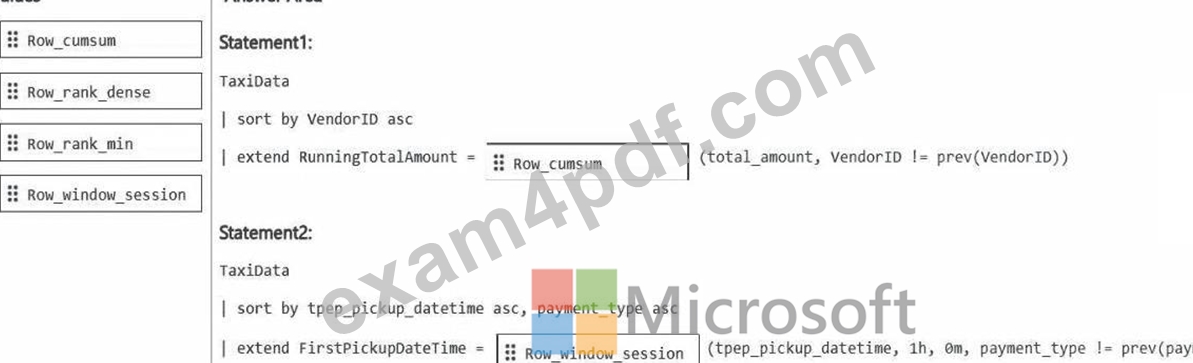
Partition the RunningTotalAmount by VendorID. - Row_cumsum
The Row_cumsum function computes the cumulative sum of a column while optionally restarting the accumulation based on a condition. In this case, it calculates the cumulative sum of total_amount for each VendorID, restarting when the VendorID changes (VendorID != prev(VendorID)).
Create a column FirstPickupDateTime that shows the first value of each hour from tpep_pickup_datetime, partitioned by payment_type - Row_window_session
NEW QUESTION # 47
You have a Fabric workspace named Workspace1. Your company acquires GitHub licenses.
You need to configure source control for Workpace1 to use GitHub. The solution must follow the principle of least privilege. Which permissions do you require to ensure that you can commit code to GitHub?
- A. Actions (Read and write) only
- B. Contents (Read and write) only
- C. Contents (Read) and Commit statuses (Read and write)
- D. Actions (Read and write) and Contents (Read and write)
Answer: B
NEW QUESTION # 48
Note: This question is part of a series of questions that present the same scenario. Each question in the series contains a unique solution that might meet the stated goals. Some question sets might have more than one correct solution, while others might not have a correct solution.
After you answer a question in this section, you will NOT be able to return to it. As a result, these questions will not appear in the review screen.
You have a Fabric eventstream that loads data into a table named Bike_Location in a KQL database. The table contains the following columns:
You need to apply transformation and filter logic to prepare the data for consumption. The solution must return data for a neighbourhood named Sands End when No_Bikes is at least 15. The results must be ordered by No_Bikes in ascending order.
Solution: You use the following code segment:
Does this meet the goal?
- A. no
- B. Yes
Answer: A
Explanation:
This code does not meet the goal because it uses sort by without specifying the order, which defaults to ascending, but explicitly mentioning asc improves clarity.
Correct code should look like:
NEW QUESTION # 49
You need to implement the solution for the book reviews.
Which should you do?
- A. Create a data pipeline.
- B. Create a shortcut.
- C. Create a Dataflow Gen2 dataflow.
- D. Enable external data sharing.
Answer: B
Explanation:
The requirement specifies that Litware plans to make the book reviews available in the lakehouse without making a copy of the data. In this case, creating a shortcut in Fabric is the most appropriate solution. A shortcut is a reference to the external data, and it allows Litware to access the book reviews stored in Amazon S3 without duplicating the data into the lakehouse.
NEW QUESTION # 50
You are building a data loading pattern by using a Fabric data pipeline. The source is an Azure SQL database that contains 25 tables. The destination is a lakehouse.
In a warehouse, you create a control table named Control.Object as shown in the exhibit. (Click the Exhibit tab.) You need to build a data pipeline that will support the dynamic ingestion of the tables listed in the control table by using a single execution.
Which three actions should you perform in sequence? To answer, move the appropriate actions from the list of actions to the answer area and arrange them in the correct order.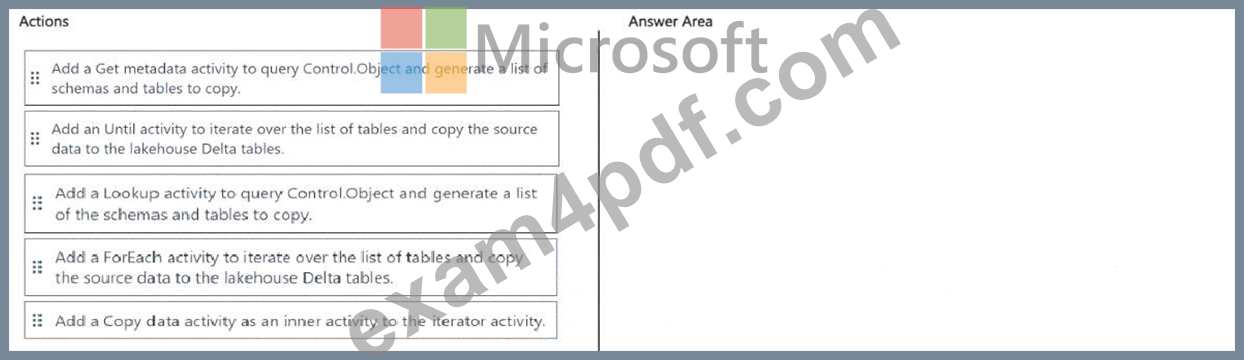
Answer:
Explanation: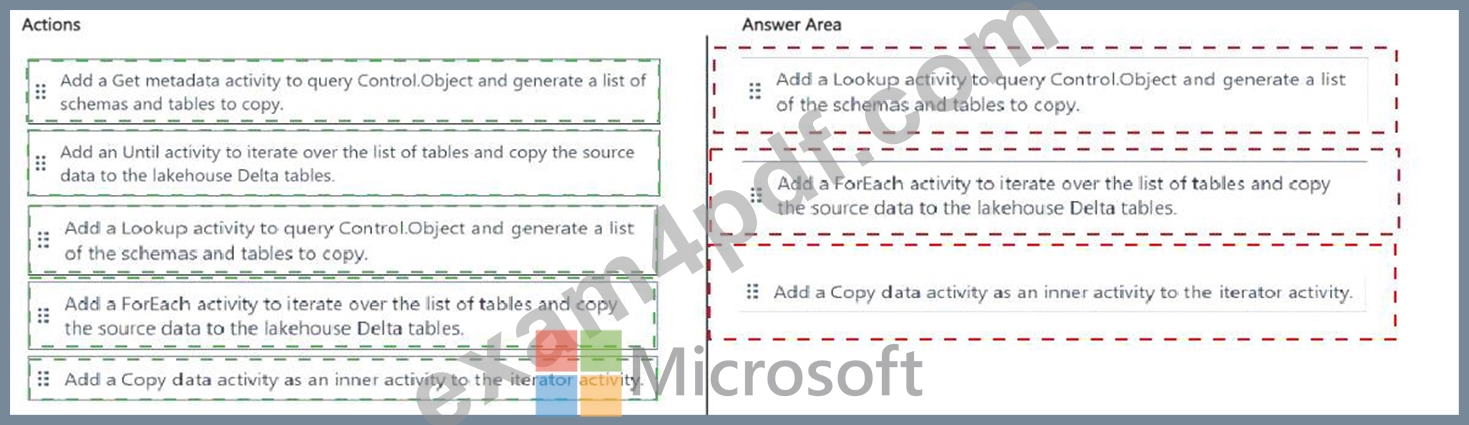
Explanation: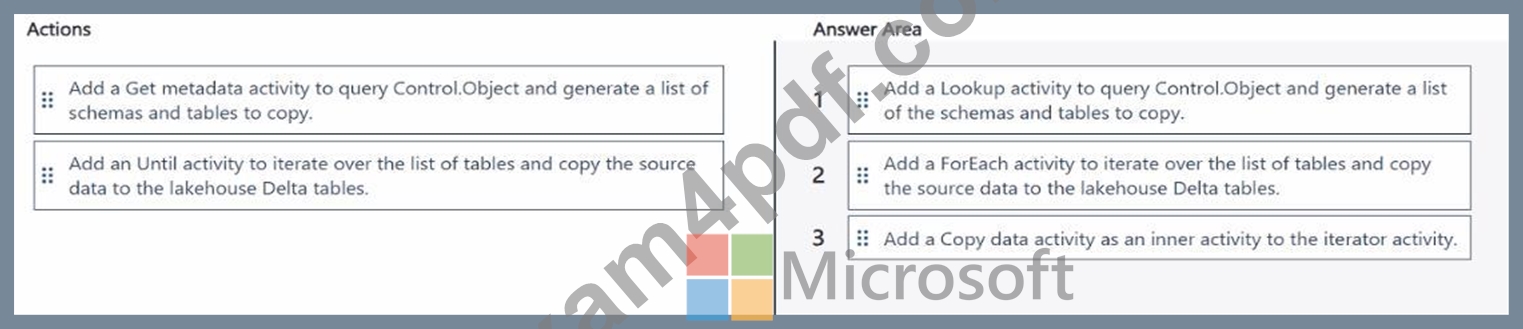
NEW QUESTION # 51
You have a Fabric workspace that contains a warehouse named Warehouse1. Warehouse! contains a table named Customer. Customer contains the following data.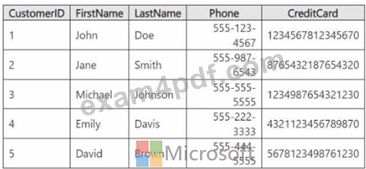
You have an internal Microsoft Entra user named User1 that has an email address of [email protected].
You need to provide User1 with access to the Customer table. The solution must prevent User1 from accessing the CreditCard column.
How should you complete the statement? To answer, select the appropriate options in the answer area.
NOTE: Each correct selection is worth one point.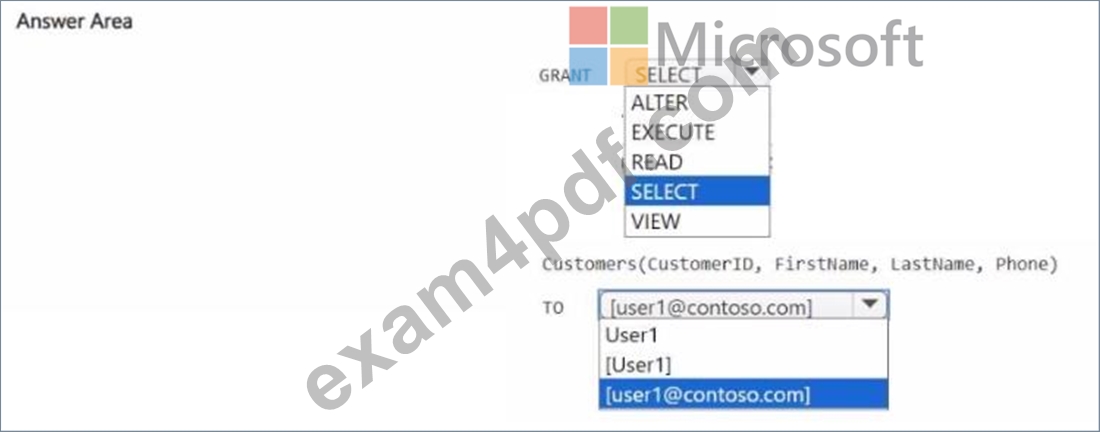
Answer:
Explanation: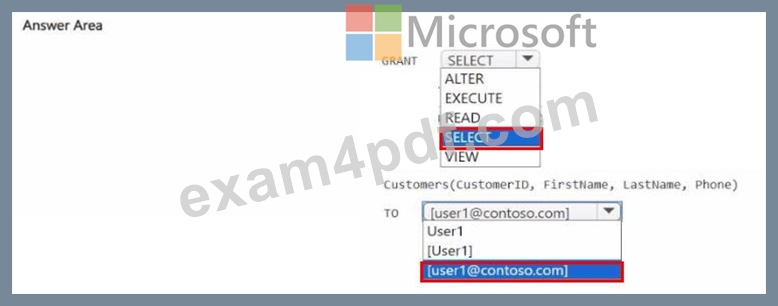
NEW QUESTION # 52
You have a Fabric workspace that contains an eventstream named EventStream1.
You discover that an EventStream1 transformation fails.
You need to find the following error information:
The error details, including the occurrence time
The total number of errors
What should you use? To answer, select the appropriate options in the answer area.
NOTE: Each correct selection is worth one point.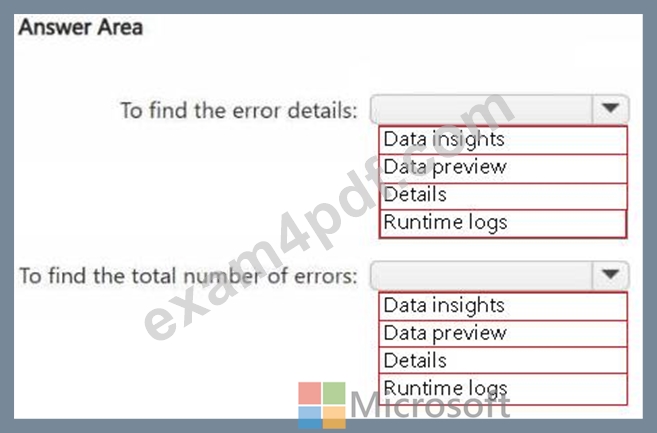
Answer:
Explanation: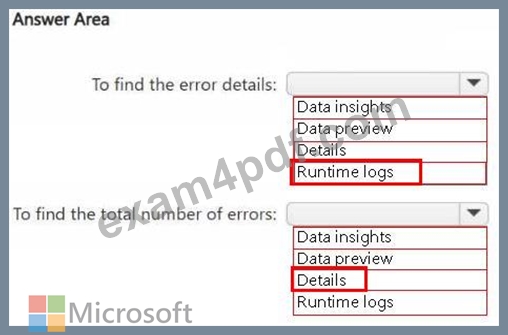
NEW QUESTION # 53
You need to schedule the population of the medallion layers to meet the technical requirements.
What should you do?
- A. Schedule a notebook.
- B. Schedule multiple data pipelines.
- C. Schedule a data pipeline that calls other data pipelines.
- D. Schedule an Apache Spark job.
Answer: C
Explanation:
The technical requirements specify that:
Medallion layers must be fully populated sequentially (bronze # silver # gold). Each layer must be populated before the next.
If any step fails, the process must notify the data engineers.
Data imports should run simultaneously when possible.
Why Use a Data Pipeline That Calls Other Data Pipelines?
A data pipeline provides a modular and reusable approach to orchestrating the sequential population of medallion layers.
By calling other pipelines, each pipeline can focus on populating a specific layer (bronze, silver, or gold), simplifying development and maintenance.
A parent pipeline can handle:
- Sequential execution of child pipelines.
- Error handling to send email notifications upon failures.
- Parallel execution of tasks where possible (e.g., simultaneous imports into the bronze layer).
NEW QUESTION # 54
Your company has three newly created data engineering teams named Team1, Team2, and Team3 that plan to use Fabric. The teams have the following personas:
* Team1 consists of members who currently use Microsoft Power BI. The team wants to transform data by using by a low-code approach.
* Team2 consists of members that have a background in Python programming. The team wants to use PySpark code to transform data.
* Team3 consists of members who currently use Azure Data Factory. The team wants to move data between source and sink environments by using the least amount of effort.
You need to recommend tools for the teams based on their current personas.
What should you recommend for each team? To answer, select the appropriate options in the answer area.
NOTE: Each correct selection is worth one point.
Answer:
Explanation: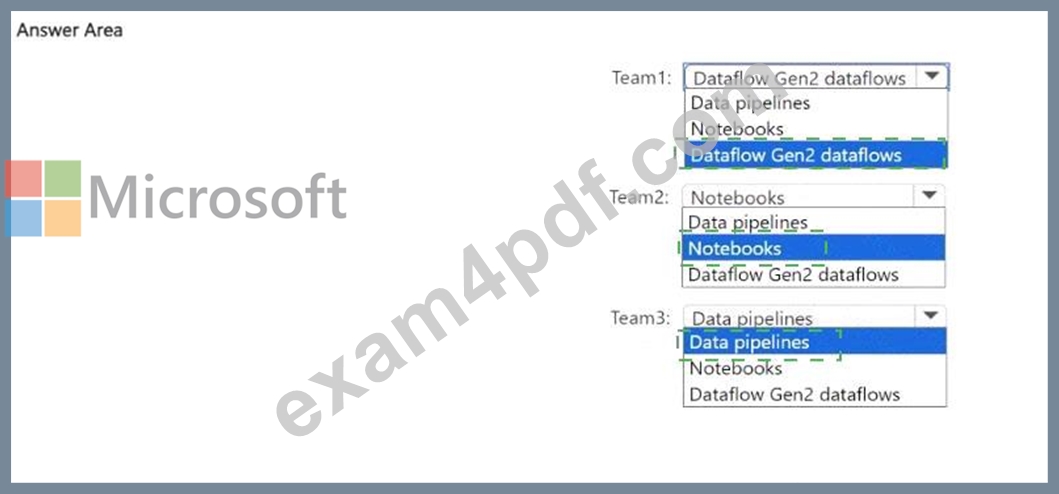
Explanation: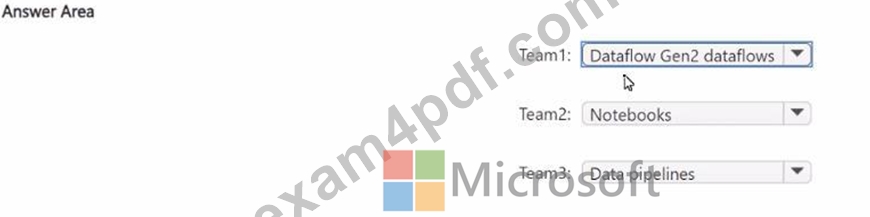
NEW QUESTION # 55
Note: This question is part of a series of questions that present the same scenario. Each question in the series contains a unique solution that might meet the stated goals. Some question sets might have more than one correct solution, while others might not have a correct solution.
After you answer a question in this section, you will NOT be able to return to it. As a result, these questions will not appear in the review screen.
You have a Fabric eventstream that loads data into a table named Bike_Location in a KQL database. The table contains the following columns:
You need to apply transformation and filter logic to prepare the data for consumption. The solution must return data for a neighbourhood named Sands End when No_Bikes is at least 15. The results must be ordered by No_Bikes in ascending order.
Solution: You use the following code segment:
Does this meet the goal?
- A. no
- B. Yes
Answer: B
Explanation:
Filter Condition: It correctly filters rows where Neighbourhood is "Sands End" and No_Bikes is greater than or equal to 15.
Sorting: The sorting is explicitly done by No_Bikes in ascending order using sort by No_Bikes asc.
Projection: It projects the required columns (BikepointID, Street, Neighbourhood, No_Bikes, No_Empty_Docks, Timestamp), which minimizes the data returned for consumption.
NEW QUESTION # 56
You have a table in a Fabric lakehouse that contains the following data.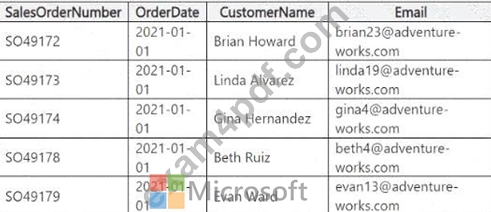
You have a notebook that contains the following code segment.
For each of the following statements, select Yes if the statement is true. Otherwise, select No.
NOTE: Each correct selection is worth one point.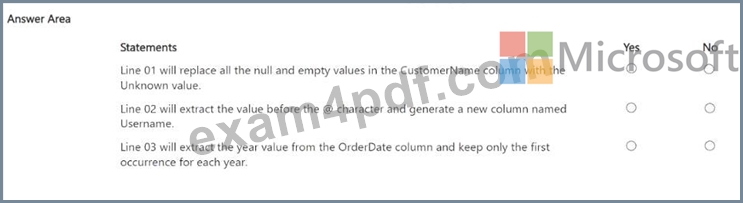
Answer:
Explanation: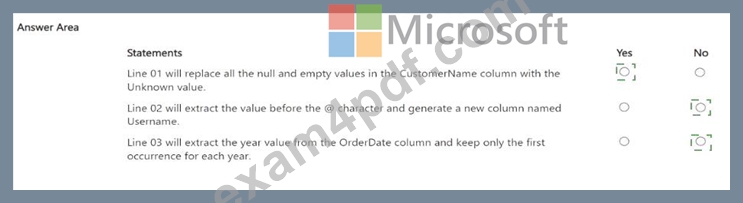
Explanation: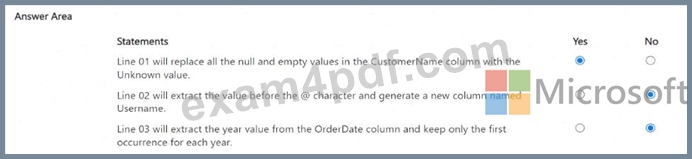
NEW QUESTION # 57
You have a Fabric workspace that contains a semantic model named Model1.
You need to dynamically execute and monitor the refresh progress of Model1.
What should you use?
- A. Monitoring hub
- B. a semantic link in a notebook
- C. dynamic management views in Azure Data Studio
- D. dynamic management views in Microsoft SQL Server Management Studio
Answer: B
Explanation:
Semantic models in Microsoft Fabric are part of Power BI datasets and require refreshes to stay updated with the latest data.
Dynamically executing and monitoring the refresh progress requires a tool or approach that integrates with Fabric's capabilities for semantic models.
NEW QUESTION # 58
You need to recommend a Fabric streaming solution that will use the sources shown in the following table.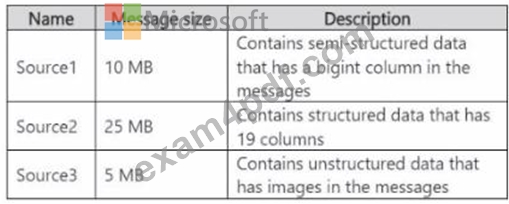
The solution must minimize development effort.
What should you include in the recommendation for each source? To answer, select the appropriate options in the answer area.
NOTE: Each correct selection is worth one point.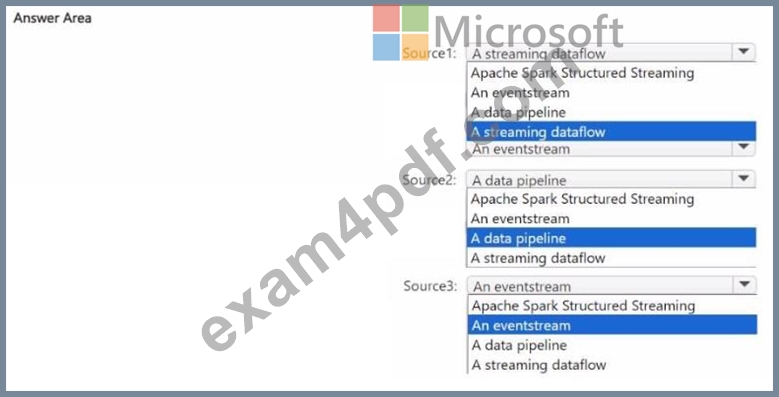
Answer:
Explanation: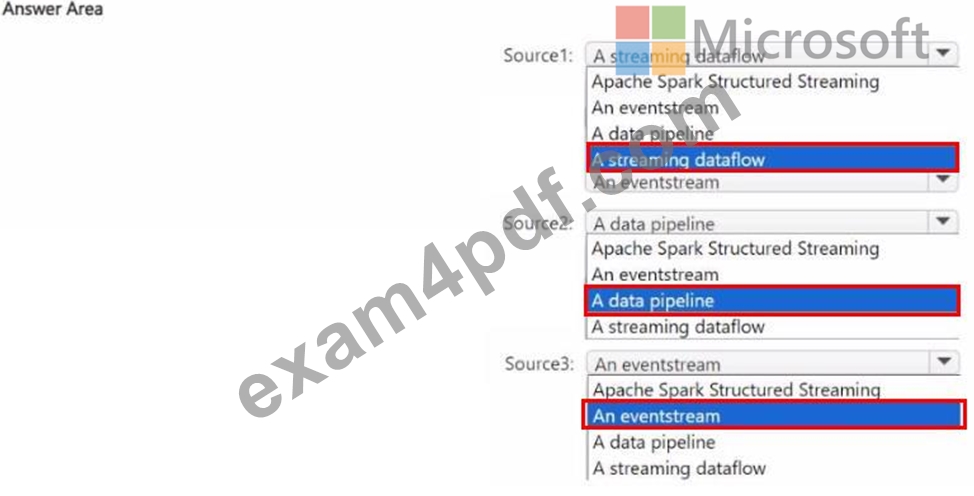
NEW QUESTION # 59
You have a Fabric workspace named Workspacel that contains the following items:
* A Microsoft Power Bl report named Reportl
* A Power Bl dashboard named Dashboardl
* A semantic model named Modell
* A lakehouse name Lakehouse1
Your company requires that specific governance processes be implemented for the items. Which items can you endorse in Fabric?
- A. Lakehouse1, Modell, and Dashboard1 only
- B. Lakehouse1, Model1, and Report1 only
- C. Report1 and Dashboard1 only
- D. Lakehouse1, Modell, Report1 and Dashboard1
- E. Model1, Report1, and Dashboard1 only
Answer: D
NEW QUESTION # 60
......
Ultimate Guide to the DP-700 - Latest Edition Available Now: https://actualtorrent.exam4pdf.com/DP-700-dumps-torrent.html
