

Get Special Discount Offer of L4M3 Certification Exam Sample Questions and Answers
New L4M3 Dumps For Preparing CIPS Certifications Certified CIPS Exam Well
CIPS L4M3 (CIPS Commercial Contracting) certification exam is a globally recognized certification that demonstrates an individual's expertise in commercial contracting. CIPS Commercial Contracting certification is offered by the Chartered Institute of Procurement and Supply (CIPS), the world's largest organization dedicated to procurement and supply chain management.
CIPS L4M3 is a professional qualification exam designed for individuals who want to develop their knowledge and skills in commercial contracting. L4M3 exam is part of the Chartered Institute of Procurement and Supply (CIPS) Level 4 Diploma in Procurement and Supply, which is highly recognized by employers in the procurement industry.
NEW QUESTION # 20
Which of the following documents are likely to have legal standing? Select TWO that apply:
- A. Requisition
- B. Estimate
- C. Quotation
- D. Request for information
- E. Tender
Answer: C,E
Explanation:
A quotation and a tender are both firm offers which have legal standing to the offeror. Tenders are more detailed than quotations and will include quality aspects as well as prices.
LO 1, AC 1.1 & AC 1.2
NEW QUESTION # 21
To expand its operation, Steel Co. decides to build a new plant. Despite of excitement, the senior management is very concerned about the complexity and risks of such project. Hugo, the procurement manager, suggests that the company can adopt a model form of contract. What is the advantage of using model form of contract?
- A. It shifts the balance of power in the favour of the buyer rather than the contractor
- B. Model form of contract eliminates the need for legal advice totally
- C. The company could avoid the need to draft a complex contract from blank
- D. The company does not need to draft the drawings as well as specification anymore
Answer: C
Explanation:
Advantages and Disadvantages of using model form contracts.
Model form contracts save a lot of time and money. They are written by industry experts and the buyers and suppliers both understand what is included in the contract.
They are mainly used in Construction and term maintenance contacts. Typical ones are JCT and NEC.
Without the use of model form contracts the buyer and supplier will take a long time to write the terms, negotiate and finalise the contract.
This is time and money wasted.
However, model form contracts require buyers and suppliers to have training so you understand them.
Finally, if you are a buyer in a powerful position you cannot exploit that with a model form contract as these are written for mutual benefit.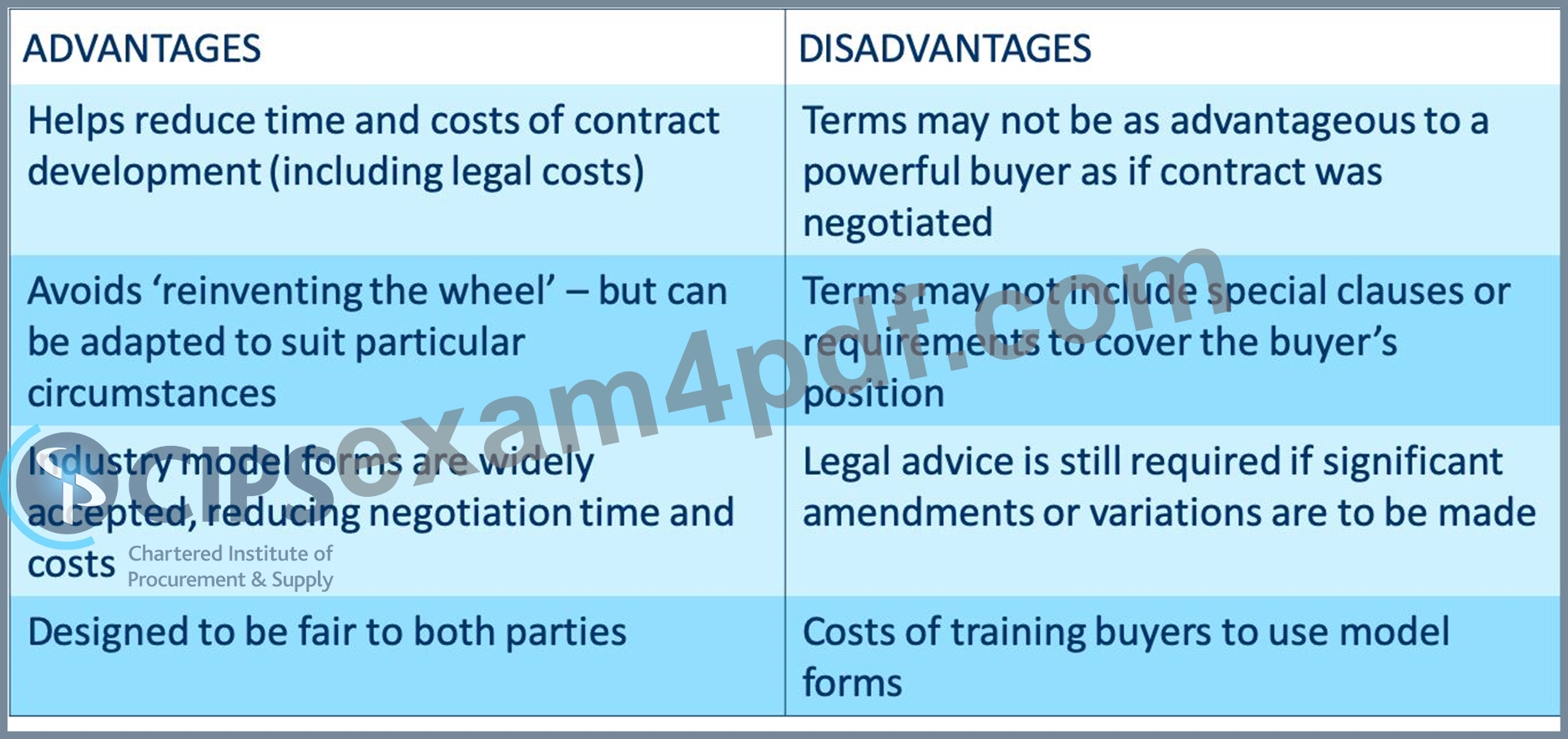
Reference:
- Procurement Study Buddy on Facebook
- CIPS study guide page 147
NEW QUESTION # 22
Which of the following standards gives guidance on the layout and preparation of specifications?
- A. BS 5864:2019
- B. BS 5975:2019
- C. BS 7373-1:2001
- D. BS EN 60601-1-11:2015
Answer: C
Explanation:
BS 7373-1:2001 Product specifications. Guide to preparation gives guidance on layout, preparation and management. The subject has been treated in a generic way and guidance can be used in the preparation of all types.
BS 5864:2019 is the standard for installation and maintenance of gas-fired ducted air heaters of rated heat input not exceeding 70 kW net (2nd and 3rd family gases). Specification BS 5975:2019 is the standard for code of practice for temporary works procedures and the permissible stress design of falsework.
BS EN 60601-1-11:2015 is the standard for medical electrical equipment. General requirements for basic safety and essential performance. Collateral Standard: Requirements for medical electrical equipment and medical electrical systems used in the home healthcare environment.
Reference:
- BSI website
- CIPS study guide page 90-92
LO 2, AC 2.1
NEW QUESTION # 23
Express terms in a contract are stated in which of the following? Select TWO that apply
- A. Writing form
- B. Orality
- C. Trade customs
- D. Statutes
- E. Idea
Answer: A,B
Explanation:
Express terms are the terms of the agreement which are expressly agreed between the parties. Ideally, they will be written down in a contract between the parties but where the contract is agreed verbally, they will be the terms discussed and agreed between the parties.
Implied terms are terms implied into the contract by the courts. They are not expressly set out in the contract but are taken to be as effective as if they were and as if they had been included from day one of the contract. The express terms and any implied terms together create the legally binding obligations on the parties.
Reference:
- Contracts: Express and Implied Terms
- CIPS study guide page 126-132
LO 3, AC 3.1
NEW QUESTION # 24
A procurement professional is preparing a sale & purchase contract of a machinery. Which of the following clauses should be added to the contract? Select TWO that apply
- A. Guarantees
- B. Supplier selection mechanism
- C. Period of hire
- D. Insurance requirements
- E. Ratio decidendi
Answer: A,D
Explanation:
The complexity of the contract will reflect the complexity of the purchase. For simple, low-value purchases, standard terms and conditions may be all that is required, but do not assume that just because the purchase is one-off, the contract will be simple. It may still need to cover the following areas:
- Warranties and guarantees if the one-off purchase has a considerable life-span and is business-critical (e.g., a back-up generator for the office which houses the national computer servers).
- Insurance requirements: including professional indemnity, public/products liability, employer's liability, and cover for any specific risks such as pollution or working at height.
- Specification requirements on quality, timing and delivery
- Minimum quality standards on the business operation (e.g., a catering provider might only be providing sandwiches for a team meeting lunch, but you still need to know its hygiene practices).
- Built-in change process for any goods or services that are beyond very simple (e.g., works contracts always have variations procedures because of the unpredictable nature of such projects).
- Ability to extend the scope of the contract should be minimal or none, and restrained to the single requirement.
- Ability to extend the duration of the contract should be limited to the ability to accommodate unexpected time overruns (which itself should be subject to a damages/penalty provision where they are attributable to the supplier, and an extension to overheads costs where they are attributable to the purchaser).
- Data security protocols need to be considered if personal data is being shared.
Reference:
LO 1, AC 1.3
NEW QUESTION # 25
When a supplier signs an insurance policy with an insurance company, which of the following is transferred to insurance company?
- A. Contractual obligation
- B. Right
- C. Legal responsibility
- D. Risk
Answer: D
Explanation:
An insurance policy transfers a specific set of risks such as the fire and flood risk for a particular asset.
The legal liability does not transfer to the insurance company (known as insurer).
Reference:
LO 3, AC 3.2
NEW QUESTION # 26
Blakenall District Hospital (BDH) is a large hospital that is a major part of the government's health service. Purchasing staff are in the habit of placing many long-term contracts with suppliers and sub-contractors. Whilst these contracts are usually carried out successfully, prices are often paid that are well over budget. The purchasing manager is concerned to find that, in some cases, members of staff are forcing suppliers to accept fixed price contracts. The policy has caused several problems such as some suppliers refusing to deal with BDH and a few going out of business mid-way through performing a contract with BDH. This is due to fluctuating market prices of materials. The procurement manager suggests supplier to adopt variable pricing arrangement with price index. Is this a right course of action?
- A. Yes, this type of arrangement would provide absolute certainty when budgeting
- B. No, variable pricing would only benefit the suppliers
- C. No, price adjustment should be applied to short-term supply contract only (3-month duration or less)
- D. Yes, this pricing arrangement would reimburse the fluctuation of material prices
Answer: D
Explanation:
Procurement staff in the Hospital is forcing suppliers into fixed price contract. If the costs generally rise, supplier may operate at a loss. This situation can disrupt the relationship, that is the reason why some suppliers refusing to deal with BDH and a few going out of business mid-way.
Alternative methods could be variable pricing arrangement. This method would reimburse the fluctuation of market price. It will also benefit buyer if the market price drops. This type of arrangement should be applied to long-term contracts (i.e. 18 months or more).
Reference:
LO 3, AC 3.3
NEW QUESTION # 27
Which of the following best defines an 'express' term in general contract arrangements?
- A. It is clearly agreed between the parties, and is virtually always written down in the contract
- B. It is the term that is added to the contract by the law or based upon the facts of the case.
- C. It is a standard set of terms and conditions published by CIPS
- D. It is not necessarily discussed by the parties, but nonetheless forms part of the contract
Answer: A
Explanation:
Express terms are the terms of the agreement which are expressly agreed between the parties. Ideally, they will be written down in a contract between the parties but where the contract is agreed verbally, they will be the terms discussed and agreed between the parties.
Implied terms are terms implied into the contract by the courts. They are not expressly set out in the contract but are taken to be as effective as if they were and as if they had been included from day one of the contract. The express terms and any implied terms together create the legally binding obligations on the parties.
Reference:
- Contracts: Express and Implied Terms
- CIPS study guide 126-132
LO 3, AC 3.1
NEW QUESTION # 28
Which of the following are reasons why a buying organisation adopts a model contract?
1. Extremely advantageous terms for buyer
2. Correct legal terminology
3. Supplier cannot make variation to the model form
4. Specific to industry
- A. 1 and 4 only
- B. 1 and 2 only
- C. 2 and 4 only
- D. 2 and 3 only
Answer: C
Explanation:
Advantages for the use of model forms of contract include:
* Helps to reduce the time and cost in contract development, particularly in detailed negotiation of terms and conditions.
* Avoids starting from the beginning each time, avoids" re-inventing the wheel" each time.
* Model contract forms may be widely accepted by both buyers and sellers across the industry or sector.
* Model contract forms are even handed and designed to be fair to both parties in the contract.
* Model contract forms include standard clauses that can be selected or deleted on an as required basis.
* Model contract form's standard clauses are more likely to contain the correct legal terminology without recourse to third party experts.
Disadvantages of this type of contract include:
* Terms may be less advantageous, than may be achieved through negotiations, particularly where there is one party who is much stronger than the other.
* The generic contract may be difficult to adapt to the specific circumstances between two parties.
* Terms may not necessarily include special clauses or requirements to cover a particular or unusual situation.
* Legal advice and input may still be required, particularly where significant variations to the norm are required.
* There may be costs associated with training staff in the detailed application of the model forms of contract.
Reference:
- D5 Sample QUESTION and answer
- CIPS study guide page 147
LO 3, AC 3.1
NEW QUESTION # 29
You are to do the KPIs and targets for international supplier and the following was done
1. Delivery in an hour
2. Return orders in an hour
Is that a good thing or not?
- A. Yes, the higher the targets are, the better the outcomes will be
- B. Yes, because these targets will propel the suppliers to continuous improvement
- C. No, the local suppliers are always the best choice
- D. No, because the KPIs are not a realistic and justified
Answer: D
Explanation:
KPIs and the targets for supplier should be SMART:
- Specific: What exactly do you want to achieve?
- Measurable: How will you identify that you have achieved your goal?
- Achievable: Is your goal really attainable?
- Relevant: Is it relevant to you or, in other words, does it align with where you want to be?
- Time-bound (or timely): When will you deliver your goal, and what are the key milestones?
The two KPIs (Delivery in one hour, Return orders in one hour) are not realistic and achievable for international suppliers. Therefore, you should not put such high targets for supplier.
Reference:
- What Are SMART KPIs? (Spoiler: They Don't Really Exist!)
- CIPS study guide page 107-108
LO 2, AC 2.2
NEW QUESTION # 30
CMS Corp goes into a gainshare agreement with the contractor, EIP Ltd. Both parties agree that the final fee will be calculated on target cost - target fee basis. Which of the following will affect the final fee payable in this gainshare agreement? Select TWO that apply:
- A. Accrual expense
- B. Purchaser goodwill
- C. Supplier share
- D. Actual cost
- E. Final price
Answer: C,D
Explanation:
An incentive contract is a sub-segment of a fixed-price or cost-reimbursement contract when there are specific cost or time commitments that are desired for a project. The standard incentive contract will allow for a fixed price to be paid for work to be completed by a specific deadline and at a specific cost.
There are two major types of incentive contracts: Cost-plus-incentive fee and Fixed-price incentive (firm target) contracts. Both types have the same formula for calculating final fee and final price.
The target fee is the amount that will be paid if the actual costs (which can be proven) match the target costs The actual fee will be adjusted in proportion to the difference between the target cost and the actual cost. The usual calculation is:
Target fee + ((target cost - actual cost) x Supplier share) = final fee The final price then becomes:
Actual cost + final fee = final price
Reference:
LO 3, AC 3.3
NEW QUESTION # 31
Which of the following are features of performance specification?
1. Method of achieving the buyer's desired result
2. What needs to be achieved when using the product
3. Purposes of the product
4. Technical and physical characteristics of the product
- A. 1 and 4 only
- B. 2 and 4 only
- C. 1 and 2 only
- D. 2 and 3 only
Answer: D
Explanation:
There are 2 major types of specifications:
1. Performance specifications
These are Specifications that define the purpose of the goods or services in terms of how effectively it will perform. Performance is a logical extension of function. Performance specifications define the task or desired result by focusing on what is to be achieved. They do not describe the method of achieving the desired result.
2. Technical (or conformance) specifications
These are Specifications that define the technical and physical characteristics and/or measurements of a product, such as physical aspects (e.g. dimensions, colour, and surface finish), design details, material properties, energy requirements, processes, maintenance requirements and operational requirements. They are used when functional and performance characteristics are insufficient to define the requirement and are often used for engineering and information technology requirements.
Reference:
- Specification Writing
- CIPS study guide page 9-11
LO 1, AC 1.1
NEW QUESTION # 32
A tire manufacturer entered into a contract with a distributor. In the contract, the distributor is prohibited from selling the tire under the price list. The distributor must pay $5 for each tire sold in breach. The amount of $5 is known as...?
- A. Liquidated damages
- B. Quantum meruit
- C. Caveat Emptor
- D. Penalty
Answer: A
Explanation:
This scenario is in fact based on a famous case law: Dunlop Pneumatic Tyre Company v New Garage & Motor co [1915] AC 79. In this case law, the House of Lords identified the clause as liquidated damages, and therefore enforceable.
However, if this case had happened in 2015 or afterwards, there would be some legal issues:
- The price agreement is prohibited by Competition Act 1998
- If the agreement is allowed by Competition Act, as in the case Cavendish Square Holding BV (Appellant) v Talal El Makdessi (Respondent), the clause can also be identified as a penalty and it is still enforceable.
Reference:
LO 3, AC 3.2
NEW QUESTION # 33
In which of the following conditions, request for quotation produces the best results?
- A. Under framework agreements
- B. With strategic items
- C. Under a complex process
- D. With an ambiguous specification
Answer: A
Explanation:
Request for quotation has valuable function when its use is properly controlled. It works the best under framework agreements where the contract terms are already fixed.
Reference:
LO 1, AC 1.1
NEW QUESTION # 34
CISG will be most likely to apply to which of the following transactions?
- A. Sale of electricity
- B. Sale of a ship
- C. Sale of a property
- D. Sale of iron ores
Answer: D
Explanation:
Article 2 of CISG states that:
This Convention does not apply to sales:
(a) of goods bought for personal, family or household use, unless the seller, at any time before or at the conclusion of the contract, neither knew nor ought to have known that the goods were bought for any such use; (b) by auction; (c) on execution or otherwise by authority of law; (d) of stocks, shares, investment securities, negotiable instruments or money; (e) of ships, vessels, hovercraft or aircraft; (f) of electricity.
LO 1, AC 1.2
NEW QUESTION # 35
A procurement manager is preparing a long-term contract with a major supplier. She decides to use the variable pricing arrangement using price indices. The payment terms describe the circumstances and mechanism where the price is allowed to change. In order to successfully manage this type of contract, the buying organisation should have...?
- A. Selection of base year
- B. Value for money
- C. Good market knowledge
- D. Economy of scale
Answer: C
Explanation:
There are several approaches to price adjustment for long-term contract. Describing circumstances and mechanism is one of them. Although this approach has some limitations, it is the best option. It relies on good market knowledge but provides the most equitable approach to satisfying the needs of the purchaser and the supplier.
Reference:
LO 3, AC 3.3
NEW QUESTION # 36
Which of the following statement is true about one-off contract?
- A. Ad-hoc purchase is not a type of one-off purchase
- B. Suppliers have many opportunities to improve the quality during the performance of one-off contract
- C. One-off contracts only apply to low-value, low-risk purchase
- D. One-off contracts can be used for services and works
Answer: D
Explanation:
One-off contract is the type of contract that relates to a single purchase. One-off contracts can be used for goods, services or works. One-off contract can be simple (such as buying a small number of office stationeries) or complex (such as a construction project or buying an aircraft).
A one-off contract lasts "until completion of the obligations of the parties". The performance is unlikely to be improved during contract performance since the duration is relatively shorter than framework agreement or call-off contract.
Ad-hoc purchase is an item bought for a single and non-recurring use or purpose. Ad-hoc purchase is a type of one-off contract.
Reference:
LO 1, AC 1.3
NEW QUESTION # 37
......
The Chartered Institute of Procurement and Supply (CIPS) is a globally recognized organization that offers professional qualifications in procurement and supply chain management. The CIPS L4M3 (CIPS Commercial Contracting) Exam is one of the specialized exams offered by CIPS that focuses on the legal aspects of procurement and contracting. L4M3 exam is designed for procurement professionals who are involved in commercial contracting and want to enhance their knowledge and skills in this area.
Updated L4M3 Dumps Questions Are Available For Passing CIPS Exam: https://actualtorrent.exam4pdf.com/L4M3-dumps-torrent.html
